
Second Green Revolution and dismal pulses production in India:
Dear friends,
I. Second
Green Revolution : Governments
after Governments are assuring us that they will usher in a Second green
revolution to improve agricultural production by addressing the productivity
gap and through value addition. Please
believe that they have also set for themselves an ambitious goal of two to
three times increase in the farmers’ per capita income within five years (I am hearing your heckles and giggles, my friend. Don't comment anything. Perhaps this criticism will land us in jail).
The success (?) of first Green Revolution can be
attributed to the introduction of Chemical fertilizers (N,P and K) which
increased agricultural production substantially. Even after all the sufferings
of farmers in the recent past, the worrying factor is that our policy maker’s
mind set (should I say ‘Sick’) is still in the same ‘increasing agricultural
productivity’ aspect.
The second Green Revolution may be a possibility not
by increasing Agricultural productivity but in ‘Mechanization’ and ‘Value
Addition of the harvested produce’.
II.
Dismal pulses production : Indian
Agriculture and Food Security policies have emphasized cultivation of rice and
wheat and paid least attention to coarse grains and pulses resulting in a steep
fall in pulses production and consumption by rural masses.
This is being attributed to the existing
agriculture and food security policies, which have emphasized cultivation of
rice and wheat to the exclusion of coarse grains and pulses which traditionally
have been the primary source of protein for the rural poor.
After a steep fall in pulses production and
consumption, our Govt. opened its eye to ‘Introduction of Special initiative of
Accelerated Pulses Production Programme (A3P)’ in 2010 under NFSM pulses
programme to boost the production of pulses (Red gram, green gram, black gram,
Chick pea and lentil) by active promotion of production and protection
technologies in 1000 clusters of 1000 hectares each with a hand holding approach.
Seeds, Protrays, polythene sheets for usage as weed
mat, MN mixture (‘Pulse wonder’ a MN enriched fertilizer developed by TNAU is
supplied in TN), Water soluble fertilizers and DAP are available at subsidized
cost under this program. Micro irrigation is provided exclusively for pulses in
an area of 5000 Ha, wherein portable sprinklers and rain-guns are also
earmarked to the farmers at subsidized cost. It is programmed to upscale and
adopt this technology in an even more grand scale in the coming years also.
As a result of active 'A3P' implementation coupled
with better crop management the customary image of pulses as 'rain fed crop' changed to that of pulses as 'irrigated pure crop'. A3P implementation has also
resulted in increased Redgram (Pigeon pea / Thuvarai) area from 0.26 Lakh Ha.in 2009-10 to 0.60 Lakh Ha.in 2010-11 and fall in food grain
production in some states which is not a cause for concern since we are already
producing more food grains than what is necessary for our country.
Impressed with my post on ‘Red Gram’ (Pigeon pea /Thuvarai) in this blog, Mr.N.madhubalan,
Assistant Director of Agriculture, Dharmapuri Dt, Tamilnadu had sent some
photographs to share with our readers. He claims that he had selected 500 farmers to implement 'Accelerated
pulses production program' in 150 ha, NADP-151 Ha. and NFSM in 100Ha.
and satisfied with the rate of acceptance among the farmers about this modern
pulses cultivation technology.

Transplanting Redgram (Pigeon pea / Thuvarai) is the new technique:
In pic. above: Germination of seeds in 98 cavity Plugtrays or protrays.
In pic. below: Seedlings transferred to polybags and raising them for 1 month before transplanting in the main field at favorable climatic conditions.
Benefits of this technology are:
- to save seeds as only 2 - 3 kg is required for 1Ha,
- to avoid damage to seeds by drought or heavy rains,
- to avoid late sowing and adhering to correct crop season,
- to maintain higher plant population,
- to maintain correct plant spacing,
- to increase the rate of 'rhizobium' inoculation,
- to reduce the chances of Nematode attack to young seedlings,
- to increase drought tolerance because of deep rooting,
- to save two manual de-weeding costs,
- to reduce the chances of pest attack,
- to reduce the Fertlizer and Pesticide wastage at the first month,
- to reduce the cost of applying them,
- and to get more yield.

Innovation in cult. tech.1: Instead of the above procedure, raising seedlings in 'Root trainers' is the best option. It eliminates transplant shock and the cost of transferring seedlings from 'protrays' to 'polybags'. Handling of root trainers in the field at the time of planting is also very easy and damage to the plants can be avoided altogether. (Picture: An illustrative Example only).
 According to experts the actual yield in India for red gram is 700 Kg against its actual yield potential of 3000 Kg / Ha. We can definitely bridge this wide gap between yield potential of a crop and actual yield in the field by adopting to latest technologies only. (Click this link).
Note 1: My post on 'Redgram (Pigeon pea / Thuvarai) cultivation' in this blog is one of the most read article surpassing 'Melia' and 'Gmelina' posts in terms of readership. My personal experience in the cultivation of Pigeon pea (yield attained:1750 Kg/Ha) is explained in detail in this link.

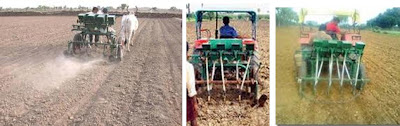
Innovation in Mechanization 1.Tropicultor : Though there are many companies supplying 'Seed Drills' in India, a multipurpose equipment for small farmer's need is somewhat difficult to find. So, I can say that a major break through in technology is the introduction of an implement called as 'Tropicultor' by ICRISAT, Hyderabad, that can be drawn either by animal or Tractor. It is a multipurpose implement that executes
land preparation, seed and fertilizer placement, weeding, bund formation and
earthing operations. The implement costs
about Rs.50,000 and is designed and supplied by ICRISAT.

Link 3 : Details of 'Tropicultor'.
Innovation in Mechanization 2. Combined harvesters for pulses: Nowadays farmers in Tamilnadu are using the same combined harvesters that are designed to harvest Paddy for harvesting all types of pulses also by changing the mesh required for separation of grains depending upon the pulse variety that is to be harvested. Total cost to harvest one acre comes to about Rs.1000 only. Link : Mechanized harvester for pulses.
I would like to conclude by again saying that
succour to Indian farmers may be a possibility not by increasing Agricultural
productivity but in ‘Mechanization’ and ‘Value Addition of the harvested
produce’.
Note 1: My post on 'Redgram (Pigeon pea / Thuvarai) cultivation' in this blog is one of the most read article surpassing 'Melia' and 'Gmelina' posts in terms of readership. My personal experience in the cultivation of Pigeon pea (yield attained:1750 Kg/Ha) is explained in detail in this link.
Note 2: About ‘Pulse wonder’:
It is a micro nutrient enriched fertilizer developed by 'Tamil Nadu
Agriculture University'
In addition to major nutrients (NPK), ‘Pulse Wonder’ also contains micro nutrients such as iron and boron and plant hormones known as 'auxins' to promote growth.
'Pulse Wonder' should be applied at the time of flowering and fruiting to enhance yields by 10-20 per cent. It decreases flower shedding and increases drought tolerance in pulse crops.
Dosage for 1 acre: Dissolve 2.5 Kg of 'Pulse wonder' + 300 ml of 'Wetting agent' in 200 litres of water and spray it as foliar application on pulse crop during early morning hours.
In addition to major nutrients (NPK), ‘Pulse Wonder’ also contains micro nutrients such as iron and boron and plant hormones known as 'auxins' to promote growth.
'Pulse Wonder' should be applied at the time of flowering and fruiting to enhance yields by 10-20 per cent. It decreases flower shedding and increases drought tolerance in pulse crops.
Dosage for 1 acre: Dissolve 2.5 Kg of 'Pulse wonder' + 300 ml of 'Wetting agent' in 200 litres of water and spray it as foliar application on pulse crop during early morning hours.
Regards,
A.Vishnu Sankar


