Showing posts with label Timber plantations. Show all posts

Wednesday, May 9, 2012

Agroforestry for Soil health


Dear friends,

An updated version of the Power-point presentation about ‘Agro-forestry’ (Latest update on 06/05/2012) is available in this blog. This presentation has become so popular with the Agri-netizens that download requests and permission to copy it are pouring in.
The presentation can be viewed by clicking the thumbnail below:
 
The presentation has the following topics with 76 slides of good pictures and graphic illustrations. Some of them are published here:
1.     The factors influencing the farmers to adopt ‘Agro-forestry’.
2.     Farmer’s misadventure in the cultivation of ‘Money Spinning Trees’.
3.     Agro-forestry for soil health.
4.     Agro-forestry to raise ‘organic carbon’ (O.C) content of the soil.

5.     Measures to enhance soil fertility.
6.     Agriculture also contributes to ‘Green house gases’.
7.     The ‘Carbon cycle’.
8.     The concept of 33% reservation.


9.     The six Agro-forestry practices.
a)     Wind Breakers / Shelterbelts.
b)    Forest farming in shade. (Integration of trees with plants that loves shade).
c)     Alley cropping.
d)    Riparian forest buffers.
e)     Woody crop plantations.
f)      Silvo-pasture.


10.            Cropping patterns for tree crops.
                   I.            Bund planting.


                II.            As contour hedge rows.
             III.            Multitier cropping system.

 11.             Importance of mulching.
12.             List of some fodder giving trees.
13.             List of some ‘Nitrogen fixing trees’.
14.             List of ‘Economically important fast growing trees’ as recommended by the     
           Forest Department.
15.             List of trees that have gained wide spread acceptance among farmers.
16.             List of long standing, hard wood trees that have good market value.
17.             List of 12 trees that are eligible for 'NMMP' (National Mission for Medicinal  
            Plants scheme).


I kindly invite the readers to comment about the presentation 
to improve it for the benefit of all.
Regards,
A.Vishnu Sankar

Saturday, April 28, 2012

Money spinning trees

Dear Friends,

"Earth provides enough to satisfy every man's need, but not every man's greed"

The super-exploitation of the present day farmers by a handful of business people has become possible due to the fo(a)rmers' insatiable greed for money. 

Every year we have been witnessing the aggressive promotion of one tree species or other by some magazines and companies and we never bothered to verify the facts. 

In the last few years alone, the list of plants that adorned the "Hall of Fame"for a short period of time and fell flat after benefiting a select few business crooks are Vanilla, Jatropha, Teak, Mangium, Paradise tree, Red sanders, Pathimugam (Sappan wood) Etc. Etc. and the list is endless. The species in the limelight now is 'Agar' (Aquilaria species) and its fall in near future is a foregone conclusion.

In recent years, farmers are finding fault with FC&RI (Forest College and Research Institute, Mettupalayam, Coimbatore) for not providing authentic information about the cultivation technology of some trees other than Eucalyptus, Casuarina junghuhniana, Ailanthus (Perumaram), Melia dubia (Malai vembu), Anthocephalus cadamba (Vellai Kadambu) and Leucaena leucocephala (subapul or Soundal).

FC&RI has acceded to the demands of tree growers and embarked upon to establish small trial plots in their premises for the following tree species which they assume to occupy the attention of the farmers in the coming years.
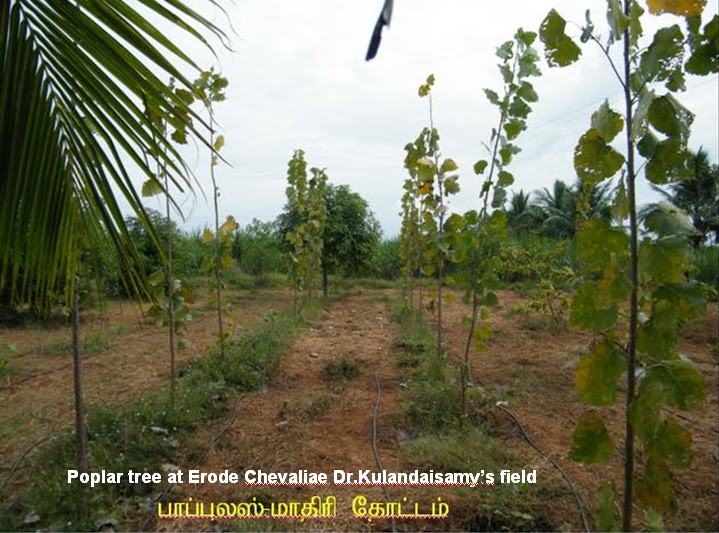
  1. Populus (Poplar) Tree.
  2. Dalbergia sissoo (A straight growing Dehradun selection)
  3. Chukrasia tabularis (Mathagiri vembu in Tamil)
  4. Poulownia tomentosa (China Teak)
  5. Salix (Willow)
  6. Acacia hybrid (Mangium X Auriculiformis)
  7. Toona ciliata (Santhana Vembu in Tamil)
  8. Dalbergia sissoo (A Dehradun selection with straight bole)
  9. Lannea coromandelica (Othiyan in Tamil)
  10. Mitragyna parviflora (Neer Kadambu in Tamil)
  11. Alstonia scholaris (Ezhilai palai in Tamil)
  12. Anthocephalus cadamba (Vellai kadambu in Tamil)
  13. Gmelina arborea (Kumil in Tamil)
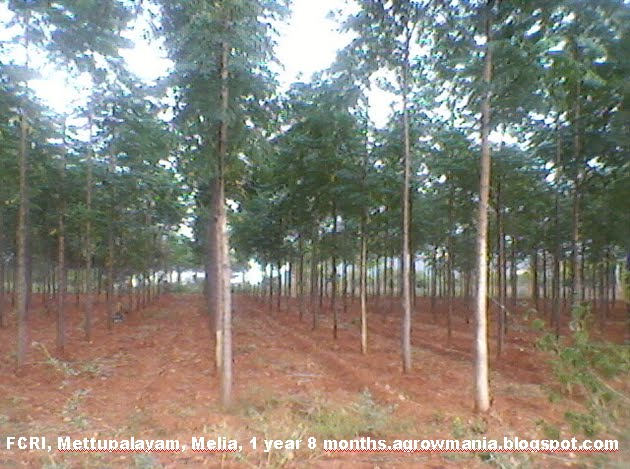
  14. Melia dubia (Malai vembu in Tamil)
The selected plants are fast growing in nature and FC&RI has done a good job by selecting a mixture of soft, medium hard and hard wood trees native to India which can be promoted after successful field trials.  
                                                                     Chukrasia

 Poplar
 
Poulownia

Alstonia scholaris:
 Anthocephalus cadamba:
 Gmelina arborea (Kumil)
Melia dubia (Malai vembu)
Tree cultivation should be done with affection, love, care, deep respect, awe and reverence. It is a sacred act and if your only aim is to spin money out of them, then be prepared to face some disastrous consequences like losing whatever wealth you have accumulated over the years.

Don't imagine! Be realistic!

Daytime robbery is going on and when will we learn the lesson?

  Please have a look at the following links:

Timber Tree selection - A Check List

A.Vishnu Sankar.

Friday, October 21, 2011

Project report for cultivation of Casuarina in irrigated condition and cultivation of Eucalyptus under rain fed condition.

Dear Friends,

A preliminary project report was prepared by me for a corporate farm last year for getting in-principle clearance from their H.O and from their Bankers. I have published that report here below with the belief that this will greatly help our fellow farmers in preparing reports for bankers with repayment schedule easily.


PROJECT REPORT FOR PULP WOOD PLANTATION
Objective:

To establish a pulp wood plantation in 500 acres in the farm lands of M/s.......... Ltd., with Eucalyptus hybrid clones and Casuarina Junghuhniana clones as main crops.


Introduction & Scope:
This report is prepared at the behest of Sri. ............, Regional Manager, ................ Ltd.,Tirunelveli by A.Vishnu Sankar, (Mob.........................), President of the Tirunelveli District Tree Growers Association and an approved contractor (Readers please note: I am not a contractor now) to undertake the Farm Forestry scheme of TNPL, Karur.


It is a welcome gesture from M/s................ Ltd., to utilize the vast tracts of cultivable drylands (rainfed farm lands) in their possession in Southern districts of Tamilnadu, to a productive cum profitable purpose with bare minimum investment.


As many farmers / corporate entities have now come to realize that the cultivation of horticulture crops in rain fed dry lands is unremunerative, most of them are turning to the most promising Agroforestry / Silviculture cultivation. Mostly, preference is given to ‘Fast Growing Trees of commercial importance’ in order to cut short the long gestation period a tree growing project normally involves.

In general the following fast growing timber trees are recommended for the plains of southern India:
1. Gmelina arborea (Kumil, Kumula maram in Tamil)

2. Melia dubia (Malai Vembu in Tamil)

3. Casuarina junghuhniana (Indonesian / Junguniana Savukku in Tamil)

4. Ailanthus excelsa (Perumaram, Pee maram, Peematti in Tamil)

5. Grewia tiliaefolia (Thadasu, Sadachi in Tamil)

6. Khaya senegalansis (Kaya or Senegal Mahogany in Tamil)

7. Albizia falcataria (Kattumaram in Tamil)

8. Pterocarpus santalinus (Red Sanders/ Sivappu Santhanam in Tamil)

9. Acacia auriculiformis (Pencil Tree in Tamil)

10. Anthocephalus cadamba (Vellai Kadambu in Tamil)

11. Eucalyptus - (Tamil: Thaila maram)

12. Bamboo (Varieties: Bambusa nutans, B. Bamboos, B. tulda, B. vulgaris, B. Balcooa)

Selection of appropriate Tree varieties:


Bearing in mind the factors such as our soil type, soil fertility, soil depth, MSL, rainfall, impossibility of providing supplementary irrigation, dry land tree cultivation in 100% rain fed condition, and above all the marketability of the wood , we can safely select only the following two varieties:

1) Casuarina junghuhniana clones
2) Eucalyptus clones.

For commercial cultivation of the above two tree species, good technical guidance, supply of high yielding clonal planting materials and buy back agreement with a reliable buyer are utmost necessity. ‘TNPL’ will naturally fit into that slot of reliable buyer with whom we can enter into a contract agreement for the cultivation of Casuarina junghuhniana clones and Eucalyptus clones under Farm Forestry scheme.

TAMIL NADU NEWSPRINT AND PAPERS LIMITED:


Government of Tamil Nadu Enterprise) Kagithapuram – 639 136. Karur District
Tamil Nadu Newsprint and Papers Limited (TNPL) is a Government of Tamil Nadu Enterprise producing Newsprint and Printing & Writing paper at its Mill located at Kagithapuram in Karur District with an installed capacity of 2.45 lakh MT per annum. TNPL is producing different varieties paper of acceptable quality primarily from Bagasse and pulpwood and currently taking up the expansion of paper production capacity from 2.45 Lac MT to 4 Lac MT per annum. TNPL, therefore, requires continuous availability of about 4.5 Lac MT of pulpwood per annum. Against this backdrop, TNPL has embarked upon development of plantation in the year 2004-05 and launched a plantation scheme called Farm Forestry scheme.

 
FARM FORESTRY SCHEME:

Through this farm forestry scheme, the Company motivates and facilitates the farmers to take up pulpwood plantation. Under this scheme, dry land farmers in the State are encouraged to cultivate pulpwood trees. The salient features of the Scheme are:
  1. Dry land farmers in the State are encouraged to cultivate pulpwood trees in their lands, which are currently barren.


  2. TNPL provides high quality seedlings/clones to the farmers at concessional rates. (Rs.3.50 / Clone).


  3. TNPL enters into an agreement with the farmers to buy the pulpwood at the prevailing market price at the time of harvest or at the minimum support price guaranteed at the time of entering into contract whichever is higher. (current price Rs.2000 / Ton).


  4. TNPL provides assistance to the eligible farmers in obtaining bank finance. The principal amount together with interest is to be repaid after the harvest.


  5. TNPL provides free technical assistance for planting and advisory services after planting of seedlings/clones in farmers' lands.


  6. TNPL arranges harvesting and transport of pulpwood from the farmers' field to factory at company’s cost.

TNPL has established an area of about 50,000 acres under farm forestry scheme involving about 10000 farmers in 15 districts of Tamil Nadu within a span of five years and is committed to raise plantation in about 15000 acres every year to attain the target of 1,00,000 acres by the end of 2012.


The above plantation scheme is being implemented throughout Tamil Nadu through 10 regional offices providing advice and technical assistance to tree growers. The designated officer of TNPL for Tirunelveli, Virudhunagar, Tuticorin and Kanyakumari District is Mr.Krishnasamy, Mob.94425 91418.


Casuarina:
All information relating to Casuarina cultivation, tips to increase yield, photographs of fields with Casuarina plantations, Clonal production centre of TNPL Etc., can be had from this blog: agrowmania.blogspot.com. Please click this 'Casuarina Link'.

Cultivation details can be also had from: http://www.fcrinaip.org/casuarina_cultivation.php

This crop requires supplementary irrigation in peak and prolonged summer that is difficult to provide by the promoters with the poor irrigation facility available at present in the field. Retaining moisture in the soil by providing flood irrigation at least once in a month is necessary for Casuarina cultivation. Though this crop is most suited for our soil, it is advisable to reduce the area under Casuarina, to eliminate risks.

So the given mandate of selecting tree crops for cultivation in 100% dryland should be altered to include this crop by providing irrigation facility.

The safest way is to go for drip irrigation system thereby we can increase the area with minimum water usage and to obtain a bountiful harvest. We can take up Casuarina cultivation in a minimum of 50 acres in the fields where water availability is adequate.


Cost of cultivation of Casuarina junghuhniana:
Please note that the cost figures and yield estimates are only symbolic and sketchy. The calculations may vary depending upon the fertility of the soil, spacing, dosage of fertilizer, irrigation schedule; proper and timely pruning and other related Good Agriculture Practices.


  • Please note that a small fraction of farmers are getting a yield of 70 Tons and above in an acre and the majority farmers are able to get only 40 Tons – 50 Tons from 31/2 to 4 years crop will explain many questions on the yield front. So a realistic,achievable target of (Average yield ) 55 tons / Acre was taken for the estimates.

'EUCALYPTUS' Cultivation:

This species is one of the fastest growing trees in the world, a favoured species for the commercial plantations companies owing to its:

● fast growth,
● greater vigour,
● drought resistant nature,
● insect resistant characters,
● adaptability to a variety of agroclimatic conditions,
● adaptability to varied soil conditions (from good to degraded soils).
● moderately salt tolerant,
● relatively fire resistant,
● strong coppice capability (Ratooning),

Details about introduction, cultivation and management of Eucalyptus can be had from this link: http://www.fcrinaip.org/eucalyptus_cultivation.php

YIELD:

The growing stock and yield in eucalyptus plantations varies considerably depending on the site, the climatic conditions and the inputs.

Eucalyptus clonal plantations perform better than seedling origin plantations. Apart from increase in productivity, the rotation period is reduced by half.

As per TNPL records, the average yield from the well managed private plantations of Eucalyptus clones is about 40 Tons/acre in 5 years.


YEAR WISE BREAKUP OF PROJECT COST FOR CASUARINA 50 ACRES AND EUCALYPTUS UNDER 450 ACRES :


CONCLUSION: Any agricultural project involves some amount of risk in it, as agriculture is subjected to vagaries of monsoon which is not under the control of the farmer. To compound the matter further, unscientific approach by the farmer without proper understanding of soil health, wrong selection of crops and inadequate funding leads to ‘high-risk zone’ that is called AGRICULTURE.

But here, we have prepared a significant project, wherein importance has been given to solutions (to risks) and thereby eliminating risks in the planning stage itself. The main ideas conceived by us to make our project a grand success are summarized here below:
  • Selecting drought tolerant tree varieties for drought prone area.

  • Both the selected crops are some of the fastest growing trees in the world.


  • Both the crops have adaptability to varied soil / agroclimatic conditions.

  • No need for fencing the crop area as cattle do not graze these two crops.

  • Possibility of theft is almost Nil when compared to Horticultural crops.

  • Reducing the area under Casuarina to our irrigation capacity.

  • Provision of drip irrigation system for Casuarina for higher yields.

  • Selection of Hybrid clonal Casuarina jughuhniana variety for higher yields.

  • Selection of Hybrid clonal Eucalyptus for higher yields.

  • Procurement of high quality planting materials from TNPL at concessional rates.

  • Planting coincides with the onset of North East monsoon, hence mortality of plants will be Nil and their establishment in the soil will be far better.

  • It has been planned to provide sufficient plant spacing for efficient use of machines instead of manpower for deweeding.

  • Marketing the harvested produce is made simpler by entering into ‘Contract agreement’ with the market leader - ‘TNPL’.

  • Harvesting cost, Loading cost and Transportation of pulpwood from our lands to the TNPL’s factory at Kagithapuram, Karur will be borne by TNPL thereby saving not only our money but also our precious time and considerable energy.

  • As Eucalyptus has coppice capability, the plantation can be retained for 18 years.


  • We can get more income from the ratoon crops of Eucalyptus because of faster and more cycles and reduced expenditure in the ratoon stages.

  • Free technical assistance for planting and advisory services after planting can be had from TNPL.

  • TNPL and M/s Forest College and Research Institute, (FC & RI) Mettupalayam are Consortia partners in the NAIP-ICAR sponsored project. Hence we can avail free technical assistance from FC & RI also.

  • We can arrange inspection of our fields by experienced officers from the ‘Forest Department of Tamilnadu’ and the scientists from ‘Institute of Forest Genetics and Tree Breeding’ (IFGTB), Coimbatore also.

Hence, considering all the above positive features I recommend you to implement the project in whole as per the project implementation schedule for attaining a 100% success in this maiden venture.

Please find here in attached a model format of ‘Contract Agreement of TNPL’ for perusal.

Thanking you,

A.Vishnu Sankar.

Sunday, November 8, 2009

Fast growing tree species for economically important commercial timber cultivation:

Dear friends,

The Forest Department of Tamilnadu, India., recommends the following list of economically important fast growing tree species for commercial timber cultivation.

Before further reading, please have a look at our list in this link which was shortlisted in consultation with T.N forest college scientists, IFGTB scientists and some reputed forest officials of CCF, APCCF and PCCF cadres.

Forest Department's recommendation comes in the FAQ section of their website (Click to view).


What are economically important fast growing tree species?

  1. Ailanthus excelsa - (Perumaram, Pee maram, Peematti in Tamil)
  2. Melia dubia - (Malai Vembu in Tamil)
  3. Kaya senegalensis - (Kaya or Senegal Mahogany in Tamil)
  4. Anthocephalus cadamba - (Vellai Kadambu in Tamil)
  5. Alstonia scholaris - (English - Blackboard tree, Indian devil tree, Ditabark, Milkwood pine, White cheesewood, Seven-leaved milk plant and Pokok pulai, Tamil - Ezhilai-Palai)
  6. Albizia richardiana - (Tamil name: ???? Readers are requested to help)
  7. Acrocarpus fraxinifolius - Common name: Pink Cedar, Acrocarpo, Australian ash and Indian ash. Tamil: Kalingi, Kurangadi, Malai konnai, Mallaykone, Mallekone and Nelrai.
  8. Casuarina junghuhniana - (Tamil: Indonesian savukku or Junguniana Savukku)
  9. Bamboo (Varieties: Malocanna baccifera, Bambusa nutans, B. Bamboos, B. tulda, B. vulgaris, B. Balcooa)
Other than the above, the following tree varieties are also classified as fast growing and economically viable for commercial timber cultivation:

10. Gmelina arborea (Kumil, Perungumil, Kumula maram in Tamil)
11.
Grewia tiliaefolia (Thadasu, Sadachi in Tamil)
12. Albizia falcataria (Kattumaram in Tamil)
13. Acacia auriculiformis (Pencil Tree. Tamil: Kathi savukku,Elai karuvel)
14. Eucalyptus - (Tamil: Thaila maram)

The following trees though not comes under fast growing category, are strongly recommended for their timber value:

15.
Pterocarpus santalinus - (Red Sanders.Tamil: Sivappu Santhanam)
16. Pterocarpus marsupium - (Indian Kino Tree. Tamil: Vengai)
17. Santalum album
- (Sandal wood. Tamil: Santhana maram)

You might have noticed that most of the trees listed above were already find mentioned somehow or other in this blogspot. The unrepresented ones will be given due importance in the coming months.

Some readers may be wondering why I have not included,

Tectona grandis - The common Teak,
Rose wood,

Haldinia Cardifolia (Tamil : Manja Kadambu ),
Caesalpinia sapppan (Tamil:
Pathimugam),
Swietenia macrophylla
- The Peruvian Mahogany,
Thespesia populnea -
(Tamil: Poovarasu)
Hardwickia binnata - (Tamil: Aachaa)
and so many other trees of some reasonable value in the above list.

Dear friends, that is a different story, worthy enough to allocate a separate post for each variety.

Regards,
Vishnu Sankar

Sunday, October 4, 2009

Timber Tree selection - A Check List

Dear Friends,

In general, farmers who wish to go for tree crops pay more attention to the cost of plants at the time of planting and the revenue they get at the time of felling the tree.

Tree cultivation should be done with affection, love, care, deep respect, awe and reverence.
Trees are very special living beings in fact our close relatives. What we breathe out they breathe in, and what they breathe out we breathe in. To sum up, tree cultivation is a sacred act nothing short of care you give to your little child.

Please bear in mind that you are into a very long term cultivation plan and any wrong selection of tree will hurt you badly. There are many factors which will greatly influence the growth of your selected tree. So try to gather as much knowledge as you do before starting any new business.

I have given here below a simple check list for your safety:

1. Do "Soil Test" and "Irrigation water analysis" and select trees that suits your soil type and water quality.

2. Select trees according to your land type. Irrigated land or Rainfed land.

3. Determine spacing for 'Bulk cropping' or Bund / border cropping. ( Know about maturity age of the tree, canopy cover and provide enough width to use mechanical weeders.)

4. Raise some Nitrogen fixing / Leguminous trees as well as deciduous trees also, in borders or among the main crop to increase soil fertility.
Casuarina varieties [Savukku in Tamil],
Albizia varieties [Vagai in Tamil],
Acacia auriculiformis [Kathi Karuvel in Tamil],
Acacia leucophloea [Velvael in Tamil],

Gliricidia sepium, [Seemai Kondrai in Tamil]
Leucaena leucocephala [Savundal /Subapul in Tamil]
,
Dalbergia sissoo [Sisu in Tamil],
Sesbania sesban [Sithakathi / Sembai in Tamil],
Sesbania
grandiflora Etc., to name a few.


5. Know about 'invasive plants' (Invasive plants are introduced species that can thrive in areas beyond their natural range of dispersal. These plants are characteristically adaptable, aggressive, and have a high reproductive capacity. Their vigor combined with a lack of natural enemies often leads to outbreak populations.)

Leucaena leucocephala [Savundal /Subapul in Tamil] and
Morinda corcia [Nuna/ Manja nethi in Tamil]
{D
on't get confused with Morinda citrifolia which is called as 'Noni'}
are some examples.
They provide good timber, fodder and firewood, yet difficult to control because of their invasive character.

6. Avoid trees that cause a nutrition depletion in the soil and allelopathic in nature. (Eucalyptus tree for example)

7. Some trees acts as Trap crop
( Ex: Gmelina arborea (Tamil : Kumil, Kumul.) So proper care in pest management is essential when you plant them near vegetable or Horticulture crops.
Also avoid planting of trees which are natural host to insect pests, near
vegetable or Horticulture crops. (Neem is an alternative host to 'Tea mosquitoes'. So avoid planting them near cashew and Mango orchards).

8. Acquire basic knowledge about :
Hedge crops,
Trees used as wind breaker,
Trees as fence,
Trees for fodder,
Trees for shade,
Trees for fruits,
Trees for bio fuels,
Trees for timber,
Trees for medicine,
Trees for match industry,
Trees for paper mills,
Trees for plywood industry,
Trees for wood fired biomass power companies,
Trees for gasifier to produce power
Trees for carpentry,
Trees for perfumes, Etc., Etc.,

9. Intercropping and Mixed cropping: (See crop combinations)
Undoubtedly Casuarina is the best tree for intercropping and mixed cropping. It can be successfully grown with short duration trees like
Ailanthus excelsa (Perumaram, Pee maram in Tamil), Gmelina arborea (Tamil : Kumil, Kumul, Melia dubia (Malai Vembu in Tamil) Etc., and with long duration trees like Teak, Mahogany, Rose wood, Red Sanders Etc.,

See Link1 for Melia dubia + Gmelina arborea mixed cropping.

Both Gmelina arborea and Melia Dubia trees have more or less same maturity age of approx. 10 to 12 years. So better select any one variety for bulk mixed planting. Normally, short and long duration tree crops are advised to plant in alternate rows so that the later establishes well after the removal of short duration trees.

Otherwise,
Melia dubia and Gmelina arborea trees can be planted in alternate rows with a spacing of 10' to 12 feet as there is found to be no noticeable root competition among them and can be harvested at the same time.

Farmers are practicing hundreds of such tree combinations as trials and knowledge is plenty among them. You may not get tree combination suggestions from our Universities, Forest colleges Etc., in writing here in India, because they have not yet completed their trials and we should not expect ratification from them for all sorts of combinations. For instance, to get a complete result involving Dalbergia latifolia (the East Indian Rose Wood -Thothakathi in Tamil) you have to wait for a min of 70 years.

10.Pruning method: When to prune and How to prune?
(Excess pruning will lead to bending of tree in the case of Sissoo and death of young plant itself in the case of
Gmelina arborea (Tamil : Kumil, Kumul.)

11. Trees that tend to dominate in mixed cropping but grow well in mono cropping like
Dalbergia sissoo (Sisu in Tamil)

12. Trees that grow better in borders and in mixed cropping but show a rather slow growth in mono cropping like
Gmelina arborea (Tamil : Kumil, Kumul.)

13. Maturity age of a tree. (Learn, when the heart wood formation starts and when it is ideal to fell a tree) For example, in the case of Pterocarpus santalinus (Red Sanders) the heart wood hardening starts from 18th year and completes by 25 – 30 years.

14. Hardness of heart wood depends upon the soil structure and quality.

15. Preharvest preparations, harvesting techniques, Reducing waste during harvest , Post Harvest technology, some need shade drying, storage period Etc..

16. Get prior permission from the Department of Forests to cut any trees even if it is in your own land and prior permission is also necessary for transporting them to the desired destination.


17. Carbon credit


Regards,

Vishnu Sankar

  ©Template Blogger Green by Dicas Blogger.

TOP