
Anthocephalus cadamba, Neolamarckia cadamba (Vellai Kadambu in Tamil)
Some snippets from IFGTB: Tree Growers Mela -2012
Part-5: Anthocephalus cadamba:
At the 'Tree Growers mela' a very informative presentation on Anthocephalus cadamba (Kadambam, Vellai kadambu in Tamil) was made by Dr.Vijayaragavan, Scientist, IFGTB, Coimbatore. His speech dealt with special features of Cadamba, + tree selection, propagation methods, nursery raising, cultivation technology, uses, economics of cultivation, yield and profit.

Southern China, India, Bangladesh, Nepal, Sri Lanka, Cambodia, Laos, Myanmar, Thailand, Vietnam, Indonesia and Malaysia.
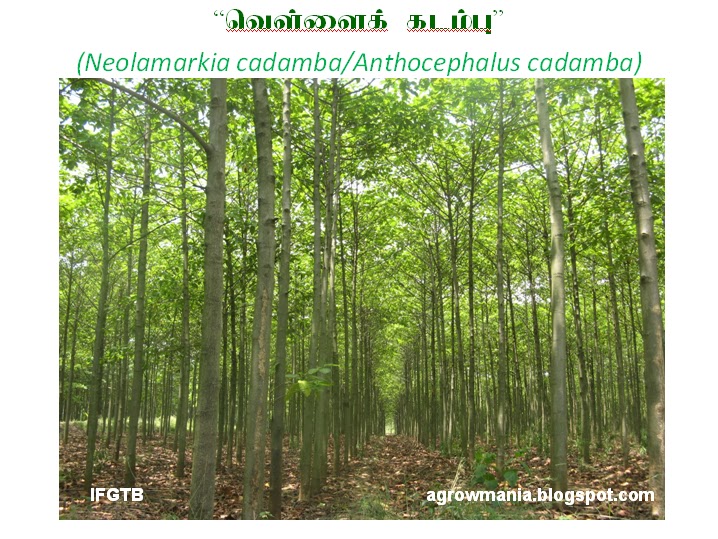
The pictures of Cadamba plantations published here were taken by the scientists of IFGTB at the farm of 'Hindustan Pencils Ltd., owners of very popular "Nataraj pencils' and 'Apsara' brands, near Coimbatore. This company is producing a mind boggling quantity of 5.6 million pencils, 1.2 million sharpeners, 2.3 million erasers, 0.16 million scales and 0.30 million pens daily (read once again 'DAILY'!).
Instead of thoughtlessly plundering trees for pencil manufacture, and relying
on forest grown timber, the company encourage renewable sources of timber by
procuring their requirement from those who grow trees on their own
farms.

The company has also ventured into developing their own timberland for raising short rotation tree crops. Since there is a wide gap between demand and
supply, there is scope for the Indian farmers to go in for the cultivation of Cadamba under
contract farming.

Fruit collection, processing and handling:
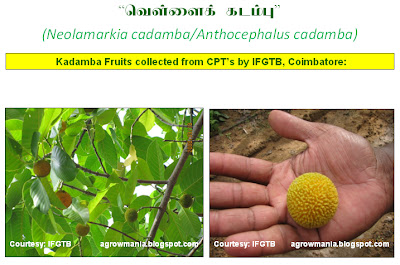
Flowering : May - June (Bisexual flowers)
Fruits : June - Feb
Germination - 90% (Germinate in 2 weeks).
Nursery:

Transplantation from mother-bed to poly-bags can be done when the seedling attain the height of 5 cm.
Propagation by 'cuttings' and Tissue culture technology:
 Pit size: 1.5 ft depth. Application of F.Y.M and Vermicompost in the pit will induce root development.
Spacing: 5m x 5m for bulk planting and 4m x 4m for border planting.
Growth: Trees grow to a height of 12m to 26 m, (2.5m growth / per year)
Girth - 70 to 125 cm

 Cadamba wood :
 Cadamba is a good shade giving tree:

Uses of Cadamba:
 Wood demand for the manufacture of pencils:
India requires 30 crores pencil / month.
'Nataraj pencils' alone produces 20 crores.
'Nataraj pencils' has manufacturing facility in J and K, Gujarat, Maharashtra and Tamilnadu.
! Cu Ft = Rs.250
Rs.250 x 11 Cu Ft = Rs.2750 per Tree.
For 400 Trees per Ha x Rs.2750= Rs.11.00L ( Approx. 9000 / Month).
Additional Income is possible from inter cropping also.
In Bund planting:
If the spacing is 3 to 4m - 130 trees.
130 x Rs.2750 = Rs.3.58 L ( Approx. Rs.3300 / Month).
Harvest cycle is 8 years in India and 4 - 5 years in other countries.
To achieve this economic gain:
Select good seedlings from nursery, cultivate in fertile soil that have good soil depth, give proper irrigation and opt for 'Contract farming',


Content and pictures courtesy:

Regards,

Trees can be grown up to MSL 1300m.
Rainfall : 500 - 1600 mm
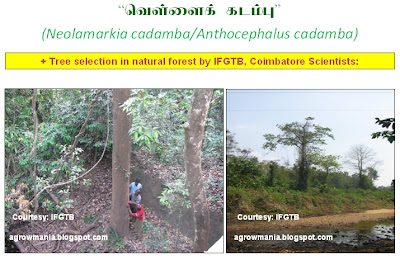
Tree selecton:
A good + tree selection in natural forests and in private plantations by IFGTB, Coimbatore has resulted in the availability superior plants of 'Kadamba' to the tree growers of India.


Fruit collection, processing and handling:
Readers are requested to Click the link: 'Nursery technique' for more information.
1 Kg will contain 9 Lakh seeds.

Flowering : May - June (Bisexual flowers)
Fruits : June - Feb
Germination - 90% (Germinate in 2 weeks).
Nursery:

Transplantation from mother-bed to poly-bags can be done when the seedling attain the height of 5 cm.
Propagation by 'cuttings' and Tissue culture technology:

Spacing: 5m x 5m for bulk planting and 4m x 4m for border planting.
Growth: Trees grow to a height of 12m to 26 m, (2.5m growth / per year)
Girth - 70 to 125 cm


Uses of Cadamba:
- Pencil making, match splints, ply-woods, pulp wood for paper, leaves as fodder and they are also used to cure throat infection.
- Fruits also have medicinal properties. Seeds have 'Anti-poison' medical properties. Crush the seeds, dissolve them in water and drink it as medicine for "Anti-poison'.
- Natural yellow dye can be extracted from the root bark.
- Due to its heavy leaf shedding nature, O.C content of the soil can be increased.
- As there is no distinct heart wood, tree can be easily sawed.

India requires 30 crores pencil / month.
'Nataraj pencils' alone produces 20 crores.
'Nataraj pencils' has manufacturing facility in J and K, Gujarat, Maharashtra and Tamilnadu.
Economics:
An 8 years old tree with a Ht of 10m and a girth of 100cm will give 11 Cu Ft of wood.! Cu Ft = Rs.250
Rs.250 x 11 Cu Ft = Rs.2750 per Tree.
For 400 Trees per Ha x Rs.2750= Rs.11.00L ( Approx. 9000 / Month).
Additional Income is possible from inter cropping also.
In Bund planting:
If the spacing is 3 to 4m - 130 trees.
130 x Rs.2750 = Rs.3.58 L ( Approx. Rs.3300 / Month).
Harvest cycle is 8 years in India and 4 - 5 years in other countries.
To achieve this economic gain:
Select good seedlings from nursery, cultivate in fertile soil that have good soil depth, give proper irrigation and opt for 'Contract farming',


Content and pictures courtesy:
Institute of Forest Genetics and Tree Breeding,
Coimbatore.
Dr.Vijayaragavan, Scientist, IFGTB, Coimbatore, Tamilnadu, India.
Dr.Vijayaragavan, Scientist, IFGTB, Coimbatore, Tamilnadu, India.
For those readers who want more specific information on Cadamba:
- Name of the plant - Anthocephalus cadamba (or)
- N’ fixing capacity - No.
- Fodder Tree - Yes.
- Deciduous - Yes.
- Drought tolerance - Can’t tolerate long drought period.
- Soil type / pH range - Deep, moist, well-drained loamy soils of alluvial origin. (Not suitable for clay soil).
- Tolerance to water logging - After sapling stage, the tree is quite tolerant of water-logged areas where the water inundates for 2-3 months.
- Seeds - Tiny seeds. About 6 kg of dry fruits yield 1 kg of seed. Each fruit on an average yields 456 mg of pure seeds. Approx. 9 – 11 lakhs seeds / kg.
- Germination - Sowing of pulped seed gives poor germination (4.85%) as compared to sieved and winnowed seed (52%).
- Vegetative propagation - Possible. Not recommended. This species is best raised by planting out entire seedlings or polythene bag raised seedlings during June – July at start of monsoon when they are about 4-5 months old.
- Spacing for border planting- 4 m x 4 m,
- Spacing for bulk planting - 5 m x 5 m
- Maturity - 8 years
- Growth : Height - 20 m Ht in its favorable habitat.
Girth - 1.5 m – 2 m
Yield - 10 to 11 Cu ft of wood in 8 years.
- Timber - The wood is white to creamy white, odourless, light in weight , straight-grained and medium and even textured. It is moderately strong, can be seasoned easily; but susceptible to sap- stain quickly after conversion, non durable; can be easily and completely treated with preservatives. Treated timber is quite durable. It saws and works easily under tools. Peels readily on a rotary lathe.
- Weight - 545 kg/cum at 12% moisture content.
- Uses - The wood is extensively used for ceiling boards, light construction work, packing cases, planking, carving and turnery. The wood makes good veneers and plywood suitable for the manufacture of grade IV commercial plywood and tea chest plywood. It is also suitable for both match boxed and splints. Tests indicate its suitability for writing and printing paper giving 48.6% yield and over 6000 m breaking length. Brown wrapping paper can also be prepared by sulphate process. Fruits are edible. Bark and leaves are used for medicinal purposes.
- Ratoon / Coppice capability - Yes, vigorous.
- Special features if any - The species is fast growing especially in the initial years. Rate of growh is very rapid in the earlier years; on an average it gives a maximum girth increment of 15 cm per annum upto the 9th year, the height increment averages 3 m per annum for the first six or eight years after which the growth becomes slower. Tends to grow vertically in the initial years without branches and then branched to form a big canopy. A beautiful majestic looking tree. Performs well in irrigated conditions. For the first 2 – 3 years irrigation is essential. Requires more sunlight and will not grow well in shades. It can regenerate well even if the branches are pruned annually for fodder. A good windbreaker.
Courtesy of the above content:
FCRI,
Mettupalayam, Coimbatore, Tamilnadu, India.
Regards,
A.Vishnu Sankar


