Wednesday, May 9, 2012

Agroforestry for Soil health


Dear friends,

An updated version of the Power-point presentation about ‘Agro-forestry’ (Latest update on 06/05/2012) is available in this blog. This presentation has become so popular with the Agri-netizens that download requests and permission to copy it are pouring in.
The presentation can be viewed by clicking the thumbnail below:
 
The presentation has the following topics with 76 slides of good pictures and graphic illustrations. Some of them are published here:
1.     The factors influencing the farmers to adopt ‘Agro-forestry’.
2.     Farmer’s misadventure in the cultivation of ‘Money Spinning Trees’.
3.     Agro-forestry for soil health.
4.     Agro-forestry to raise ‘organic carbon’ (O.C) content of the soil.

5.     Measures to enhance soil fertility.
6.     Agriculture also contributes to ‘Green house gases’.
7.     The ‘Carbon cycle’.

8.     The concept of 33% reservation.


9.     The six Agro-forestry practices.
a)     Wind Breakers / Shelterbelts.
b)    Forest farming in shade. (Integration of trees with plants that loves shade).
c)     Alley cropping.
d)    Riparian forest buffers.
e)     Woody crop plantations.
f)      Silvo-pasture.


10.            Cropping patterns for tree crops.
                   I.            Bund planting.


                II.            As contour hedge rows.
             III.            Multitier cropping system.

 11.             Importance of mulching.
12.             List of some fodder giving trees.
13.             List of some ‘Nitrogen fixing trees’.
14.             List of ‘Economically important fast growing trees’ as recommended by the     
           Forest Department.
15.             List of trees that have gained wide spread acceptance among farmers.
16.             List of long standing, hard wood trees that have good market value.
17.             List of 12 trees that are eligible for 'NMMP' (National Mission for Medicinal  
            Plants scheme).


I kindly invite the readers to comment about the presentation 
to improve it for the benefit of all.
Regards,
A.Vishnu Sankar

Saturday, April 28, 2012

Money spinning trees

Dear Friends,

"Earth provides enough to satisfy every man's need, but not every man's greed"

The super-exploitation of the present day farmers by a handful of business people has become possible due to the fo(a)rmers' insatiable greed for money. 

Every year we have been witnessing the aggressive promotion of one tree species or other by some magazines and companies and we never bothered to verify the facts. 

In the last few years alone, the list of plants that adorned the "Hall of Fame"for a short period of time and fell flat after benefiting a select few business crooks are Vanilla, Jatropha, Teak, Mangium, Paradise tree, Red sanders, Pathimugam (Sappan wood) Etc. Etc. and the list is endless. The species in the limelight now is 'Agar' (Aquilaria species) and its fall in near future is a foregone conclusion.

In recent years, farmers are finding fault with FC&RI (Forest College and Research Institute, Mettupalayam, Coimbatore) for not providing authentic information about the cultivation technology of some trees other than Eucalyptus, Casuarina junghuhniana, Ailanthus (Perumaram), Melia dubia (Malai vembu), Anthocephalus cadamba (Vellai Kadambu) and Leucaena leucocephala (subapul or Soundal).

FC&RI has acceded to the demands of tree growers and embarked upon to establish small trial plots in their premises for the following tree species which they assume to occupy the attention of the farmers in the coming years.
  1. Populus (Poplar) Tree.
  2. Dalbergia sissoo (A straight growing Dehradun selection)
  3. Chukrasia tabularis (Mathagiri vembu in Tamil)
  4. Poulownia tomentosa (China Teak)
  5. Salix (Willow)
  6. Acacia hybrid (Mangium X Auriculiformis)
  7. Toona ciliata (Santhana Vembu in Tamil)
  8. Dalbergia sissoo (A Dehradun selection with straight bole)
  9. Lannea coromandelica (Othiyan in Tamil)
  10. Mitragyna parviflora (Neer Kadambu in Tamil)
  11. Alstonia scholaris (Ezhilai palai in Tamil)
  12. Anthocephalus cadamba (Vellai kadambu in Tamil)
  13. Gmelina arborea (Kumil in Tamil)
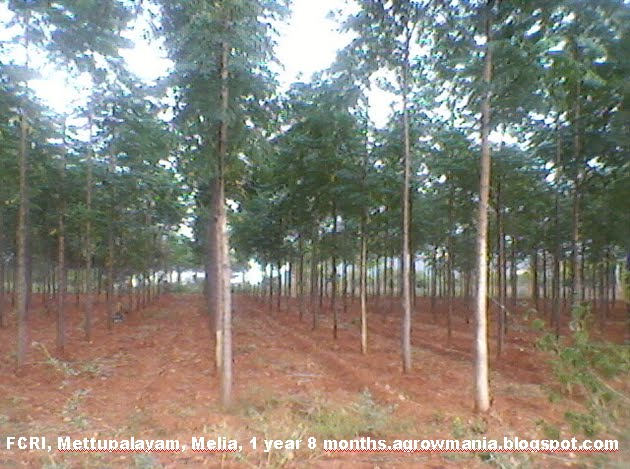
  14. Melia dubia (Malai vembu in Tamil)
The selected plants are fast growing in nature and FC&RI has done a good job by selecting a mixture of soft, medium hard and hard wood trees native to India which can be promoted after successful field trials.  
                                                                     Chukrasia

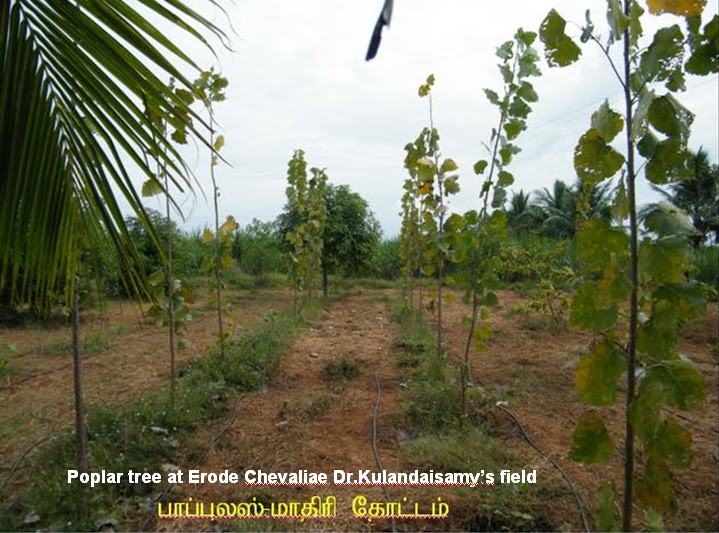
 Poplar
 
Poulownia

Alstonia scholaris:
 Anthocephalus cadamba:
 Gmelina arborea (Kumil)
Melia dubia (Malai vembu)
Tree cultivation should be done with affection, love, care, deep respect, awe and reverence. It is a sacred act and if your only aim is to spin money out of them, then be prepared to face some disastrous consequences like losing whatever wealth you have accumulated over the years.

Don't imagine! Be realistic!

Daytime robbery is going on and when will we learn the lesson?

  Please have a look at the following links:

Timber Tree selection - A Check List

A.Vishnu Sankar.

Thursday, March 22, 2012

'Wavy grain' - The smugglers choice !

Some snippets from IFGTB 'Tree Growers Mela -2012:
Part - 4
Red Sanders – Way to identify a tree with wavy grained wood without cutting the tree:

In recent years, a variant of Red sanders species which has wavy-grained wood has leapt into sudden prominence because it is highly valued in the export market. Wood pieces with the wavy grain margin are graded as "A" grade and fetch a higher price than the non-wavy wood.
Trees with this variant character are rare in nature and they seem to show no apparent morphological differences to differentiate them from the normal-grained trees. Matters have become worse lately with illegal fellers and smugglers felling non-wavy grained timber for making wood chips and wavy grained timber for logs of size 90 cm girth and 3 to 5 feet which are later stuffed with other export goods for illegal export out of country. See the kink:The Hindu.


This secret to identify a tree with wavy grain wood without cutting the tree is the most intriguing problem for the scientists throughout the world.


Dr.Parthiban, an enterprising scientist of FC&RI, Mettupalayam, Tamilnadu approached this problem in a novel way by approaching the illegal feller himself and came to know that trees with wavy grain wood will be easily identified from their seeds which carry a characteristic feature (not revealed in this blog for the safety of this endangered tree) that can not be seen in the seeds of trees with non-wavy grained wood. The secret has been revealed at last at the ‘Tree Growers Mela – 2012 held at IFGTB, Coimbatore.


P. santalinus grows as a wild plant in Cuddapah and Kurnool districts in Andhra Pradesh and Arcot and Chingelpet districts in Tamil Nadu up to 500 m.


The name Santalinus refers to its name of red Sandalwood, which all its Indian titles signify, though it bears no relationship to Santalum. This wood was primarily a dye-styff in India, where it was mixed with sapan wood, for dyeing silk, cotton and wool.


Though there is no domestic market in India, plantations have been formed for its cultivation in Southern India, where it is very rare.


CAUTION 1: It is now declared as endangered because its natural habitat is constantly subjected to human pressure. Cutting of trees in natural forests and in protected areas is totally prohibited. The legal trade in INDIA is limited to occasional auction sale of confiscated timber by Tamil Nadu and Andhra Pradesh Governments.


Cost of seedling: Seedlings are available @ Rs.8-10 per plant at almost all Govt and private nurseries.

CAUTION 2: The natural habitat of P. santalinus is hilly regions with hot dry climate. It is a strong light demander and does not tolerate overhead shade. It cannot withstand water-logged conditions. If planted in problematic soils and in soils with more clay content the plant will get stunted and there will not be any heart wood formation. In that case this high value crop will not fetch price of even fire wood.

Yield estimate: At a spacing of 15’ X 15’ roughly around 500 trees can be planted in a hectare and after 25 years minimum 250 to 500kg of heartwood/tree can be obtained. Thus one can expect 1,25,000 to 2,50,000 kg of wood from one hectare plantation. (This yield estimate is disputable and there is drastic variation in yield from place to place).


At an average market rate of Rs.150/kg an income of Rs.185 Lakhs to Rs.375 lakhs/ha is expected. (The current purchase price by the smugglers is several times more than what is given here). See the link: The Times of India.

CAUTION 3: The species is covered under the Convention on International Trade in Endangered Species (CITES) which forbids international trade of endangered timber as logs, but recent seizures in India, Nepal and in Southeast Asia suggest increasingly quantities are being smuggled.

 Red Sanders as fence along with Gliricidia in my farm.

Red sanders - Bark pattern.
Sources:

(1) Natural Product Radiance, Vol.3, Mar–April 2004, pp. 83 - 84.
(2) jawaharlal.overblog
(3) moef.nic.in/.pdf
(4) http://iwst.icfre.gov.in/ and from other web sources.


Friday, March 9, 2012

Casuarina - Species variation in wind hardiness.

Some snippets from IFGTB 'Tree Growers Mela -2012:
Part - 3
The total destruction of Casuarina plantations in Cuddalur, Pondicherry areas by cyclone 'Thane' has left many farmers to wonder whether any University or Research institute will come up with a Casuarina variety that could withstand this kind of violent on-slaught.

A Casuarina plantation before "Cyclone Thane":

After "Cyclone Thane":

Dr.Nicodemus of IFGTB, an eminent scientist has an answer to this problem. At the 'Thane' affected fields he noticed a particular Casuarina junghuhniana variety supplied by the IFGTB withstood the cyclone effectively. This variety because of its remarkable wind hardiness is selected by him for future development and multiplication.
The clones in the left half of the picture below exhibits
the character of better wind hardiness:


The selected variety stands tall even after the 'Thane' aftermath:

Those interested to purchase this variety can contact Dr.Nicodemus at IFGTB, Coimbatore.

Regards,
A.Vishnu Sankar

  ©Template Blogger Green by Dicas Blogger.

TOP